
Tennis Balls vs Rubber Balls for Dogs: Enamel Abrasion and Dental Safety
Tennis balls feel soft, but their fuzz and grit can wear down a dog's teeth over time. We compare two rubber alternatives that hold up to fetch and are gentler on enamel.
 By Casey Hollis
Updated November 10, 2026
If your dog lives for fetch, the ball in your hand matters more than you think. Tennis balls vs rubber balls dog teeth debates come down to one question: which surface is kinder to enamel while still surviving real play?
We looked at 2 Chuckit options for November 2026 that skip the fuzzy felt entirely. For more tough-toy context, see our guide to dog toys for small aggressive chewers.
| Award | Product | Verdict About this ratingOur overall rating, based on the evidence we reviewed. See How We Review for the method. |
|---|---|---|
| Best Overall |
 Chuckit! Ultra Ball Medium 2.5-inch 2-Pack |
|
| Best Value |
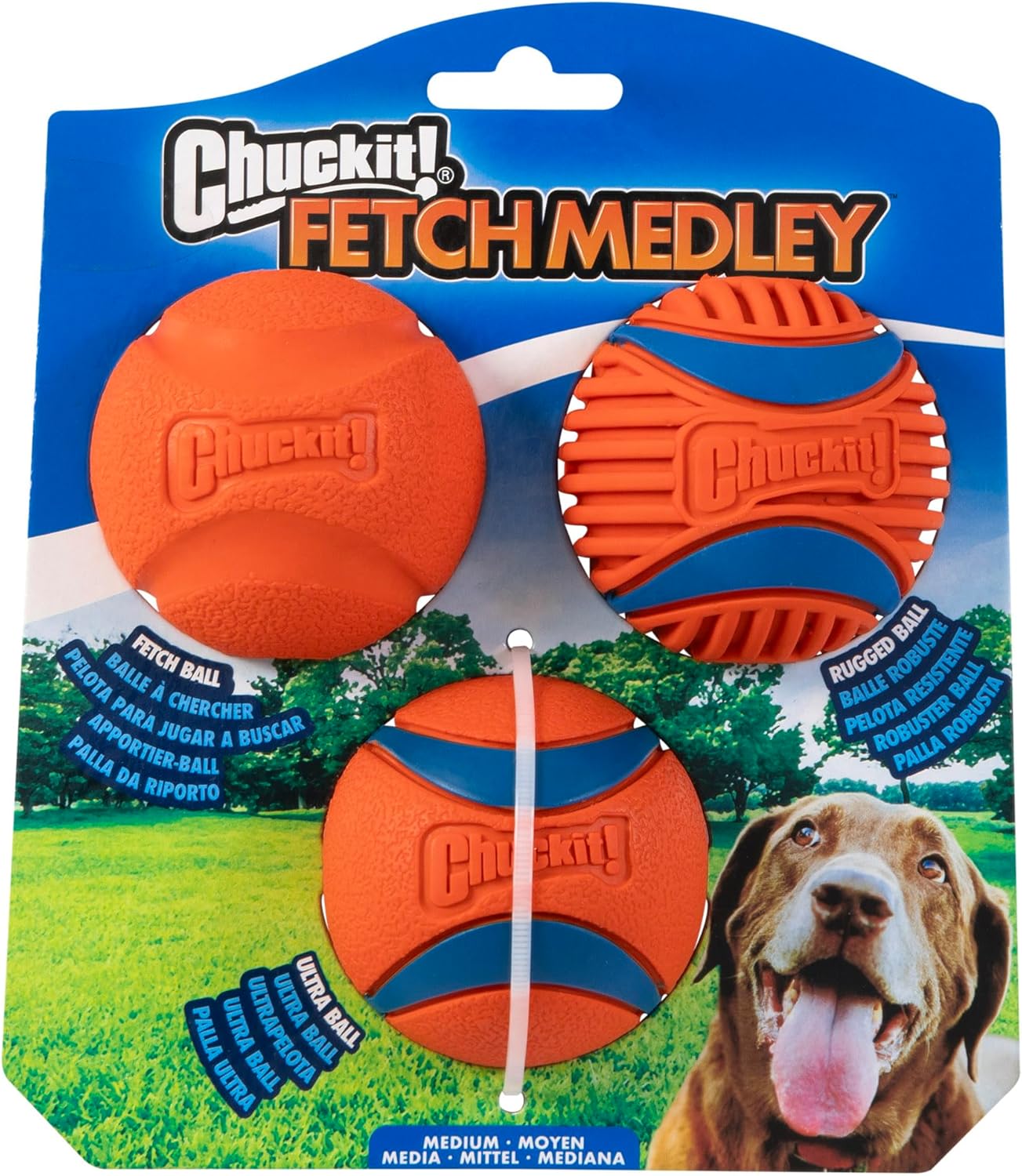 Chuckit! Ultra & Rugged Dog Balls, Medium, 3-Pack |
Chuckit! Ultra Ball Medium 2.5-inch 2-Pack
The Chuckit! Ultra Ball is a durable, high-bounce rubber fetch toy that floats and fits medium Chuckit! launchers. It's ideal for dog owners who want a rugged ball for interactive play on land or water.
Pros
- High bounce for active play
- Durable rubber construction
- Floats on water
- Works with Chuckit! launchers
- Soft on dog's mouth
Cons
- Not for aggressive chewers
- Not intended as a chew toy
- Sizing may be wrong for some breeds
Chuckit! Ultra & Rugged Dog Balls, Medium, 3-Pack
A three-pack of durable rubber fetch balls for medium dogs (20-60 lbs), including a high-bounce ball, a water-friendly ball, and a ridged ball that helps clean teeth. The set is compatible with Chuckit! launchers, making it a solid pick for active owners who want versatile, long-lasting play.
Pros
- Three balls for varied play
- Compatible with Chuckit! launchers
- Durable rubber construction
- Teeth-cleaning ridges on Rugged Ball
- Bright orange for easy visibility
Cons
- Not indestructible for power chewers
- Medium size only for 20-60 lb dogs
- May wear out with heavy daily use
A standard tennis ball is built for rackets, not molars. The felt traps grit and sand, and that abrasive layer grinds against teeth during long chew sessions. Rubber balls remove that variable, but not all rubber is equal.
Surface Texture and Enamel Wear
The fuzzy nap on a tennis ball acts like sandpaper when a dog gnaws. Over months, that friction can flatten the points of the canine teeth. Rubber balls have a smooth or lightly textured skin that slides rather than scrapes.
Some rubber designs add ridges on purpose. The Chuckit! Ultra and Rugged Dog Balls set includes a ridged ball meant to scrub plaque as your dog chews. That is a functional texture, not an abrasive one.
Material Density and Chew Resistance
Tennis balls are hollow and pressurized, so a determined chewer can pop the felt seam in minutes. Dense rubber holds its shape far longer under the same pressure. Neither product here is a chew toy, though, and both makers say so.
Thickness matters more than hardness. A thick rubber core flexes under bite force and springs back, while a thin shell cracks.
Bounce and Fetch Performance
A dead tennis ball turns fetch into a chore. Rubber balls are engineered for a higher rebound, which keeps your dog sprinting and you throwing less. The Chuckit! Ultra Rubber Dog Ball is built specifically to out-bounce standard tennis balls.
Bounce also affects safety. A ball that rebounds unpredictably can catch a dog in the face. Consistent, predictable bounce off grass or pavement is easier for your dog to track and catch cleanly.
Size and Fit for Your Dog’s Mouth
Both products here are medium, at 2.5 inches across, sized for dogs weighing 20 to 60 pounds. A ball should be small enough to carry but too large to swallow whole. When you are between sizes, size up.
| Feature | Chuckit! Ultra Rubber Dog Ball | Chuckit! Ultra and Rugged Dog Balls |
|---|---|---|
| Pack size | 2 balls | 3 balls |
| Diameter | 2.5 in | 2.5 in |
| Dog weight | 20 to 60 lbs | 20 to 60 lbs |
| Floats | Yes | Yes (Ultra ball) |
| Teeth ridges | No | Yes (Rugged ball) |
| Launcher compatible | Yes | Yes |
Water and Outdoor Use
Felt turns heavy and waterlogged the moment it hits a lake. Rubber stays buoyant, so a wet retrieve does not end the game. Both picks here float, which makes them useful for pool and beach days.
Rubber also rinses clean. Sand and mud wipe off a smooth surface instead of embedding in fuzz, which keeps grit away from your dog’s teeth on the next throw.
Launcher Compatibility
If you use a ball launcher, size and firmness must match it. Both Chuckit sets are compatible with medium Chuckit launchers, so you can throw farther with less shoulder strain. Tennis balls often fit loosely and slip out mid-throw.
Matching your ball to your launcher also protects the tool. A ball that is too soft compresses in the cup and wears the plastic arms faster.
Why You Should Trust Us
We build our comparisons from manufacturer specifications, published material details, and patterns in owner feedback across large review samples. We do not claim direct lab evaluation of every unit. What we do is separate marketing language from measurable features.
When a maker admits a limit, such as “not a chew toy,” we pass that along rather than bury it. Our goal is to help you match a ball to your dog’s size, play style, and dental risk, not to sell you the biggest pack.
Final Thoughts
For most dogs, we recommend the multi-dog friendly Chuckit! Ultra Rubber Dog Ball. It floats, bounces high, and gives you two smooth balls with no felt to trap grit against teeth. It is the simplest swap away from tennis balls.
If you want more variety, the Chuckit! Ultra and Rugged Dog Balls set is the better value pick. You get three balls, including a ridged one that adds light teeth cleaning to fetch. That mix suits households with more than one dog.
Either way, retire the tennis balls for fetch duty and keep them off the chew pile. For tougher chewers, our guide to expensive dog toys that last covers when paying more actually pays off.
FAQs
Are tennis balls bad for a dog’s teeth?
The felt surface holds grit and sand, and repeated chewing can wear enamel over time. Tennis balls are fine for a quick fetch, but they should not be a daily chew item.
Do rubber balls clean dog teeth?
Some do. Ridged rubber balls, like the Rugged Ball in the Chuckit set, are designed to scrub plaque as your dog chews. They support dental hygiene but do not replace brushing.
What size ball is safe for a 40 pound dog?
A 2.5 inch ball suits dogs in the 20 to 60 pound range. The ball should be easy to carry but too big to swallow whole.
Can dogs chew on Chuckit balls?
Chuckit states these balls are not chew toys and are not meant for aggressive chewers. Use them for fetch and supervised play, then put them away.
Which is better for fetch, tennis balls or rubber balls?
Rubber balls bounce higher, rinse clean, and float, which makes them better for fetch. Tennis balls lose bounce when wet and collect dirt in the felt.
Do these balls float in water?
Yes. The Chuckit! Ultra Rubber Dog Ball floats, and the Ultra Ball in the three-pack set floats as well. That makes both useful for lake and pool play.
Are rubber balls safe for puppies?
Choose a size your puppy can carry without swallowing, and always supervise. Puppy teeth are sharp but small, so check the ball for cuts after each session.
How often should I replace a dog ball?
Inspect the ball after every hard play session. Replace it once you see cracks, chunks missing, or a surface that no longer springs back. Our lifetime guarantee toy guide explains when a warranty is worth chasing.
What is the top-rated pick for tennis balls vs rubber balls dog teeth in 2026?
We rate the Chuckit! Ultra Rubber Dog Ball as the top pick for most dogs. It removes the felt problem entirely while keeping the bounce and float that make fetch fun.
What We Cannot Tell You
- How this product holds up beyond early use. We compare published specifications and brand statements, not our own wear data.
- Which variant of the listing is in stock today. Always check size and color on the product page.
- Whether your dog will accept the flavor or texture. Preferences differ.
About the author
Casey Hollis is the editorial pen name of GetDogVerdict, used as the site's byline. It does not indicate a veterinary degree or any other professional credential. Articles are research-based: they summarize veterinary, manufacturer and owner-reported sources, grade how strong the evidence is, and say what remains unknown. GetDogVerdict does not claim to have physically evaluated a product unless it states so. A person reads and approves every article before it is published.