
Best Dog Toys for Rescue Dogs: Separation Anxiety & Anxious Chewer Picks
Rescue dogs often arrive with chewing habits, anxiety, and no idea what a toy is for. These picks give them something safe to redirect all of that energy into.
 By Casey Hollis
Updated November 21, 2026
A rescue dog does not walk through your door with a toy history. Many have never owned one, and some have learned that chewing is the only thing that reliably relieves stress. That is why the toys you offer in the first weeks matter more than any other gear you buy.
We looked at 3 best dog toys for rescue dogs in November 2026, judging each by durability, safety, and how well it redirects nervous energy. If your household already has more than one dog, our guide to dog toys for multi-dog homes covers the sharing problem separately.
| Award | Product | Verdict About this ratingOur overall rating, based on the evidence we reviewed. See How We Review for the method. |
|---|---|---|
| Best Budget |
 Benebone Wishbone Dog Chew Toy, Medium |
|
| Best Overall |
 FIREOR No Stuffing Squeaky Plush Dog Toys 5 Pack |
|
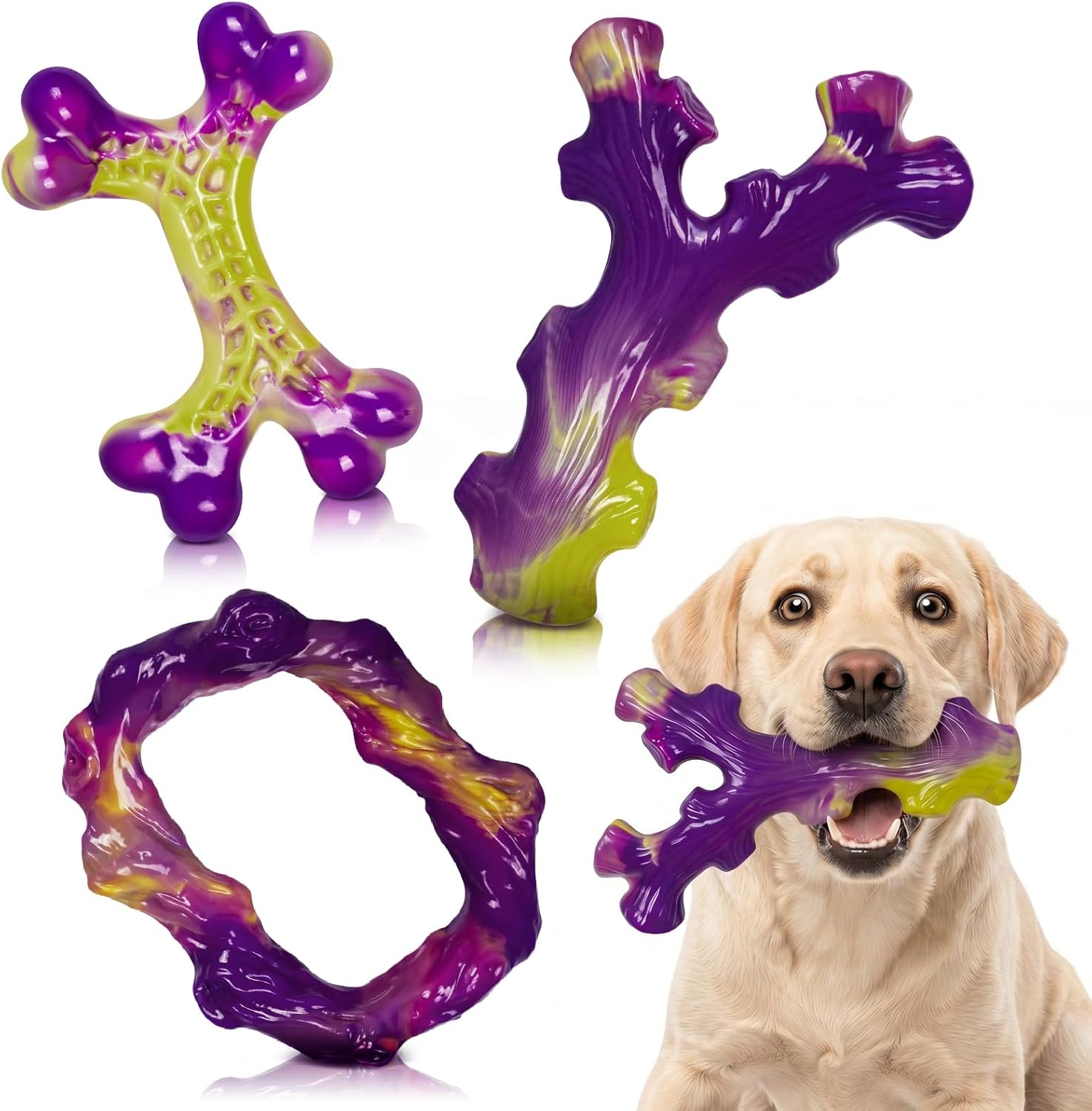 Frienhund Tough Dog Toys for Aggressive Chewers 3 |
Benebone Wishbone Dog Chew Toy, Medium
The Benebone Wishbone is a durable nylon chew toy for aggressive chewers, flavored with real bacon. It's a solid pick for dog owners who need a long-lasting chew that also supports dental health.
Pros
- Extremely durable for aggressive chewers
- Real bacon flavor dogs love
- Easy for dogs to grip and hold
- Helps clean teeth and massage gums
- Made in the USA
Cons
- Not suitable for households with nut allergies
- Not water resistant
- Requires supervision and replacement when worn
FIREOR No Stuffing Squeaky Plush Dog Toys 5 Pack
A five-pack of stuffingless plush woodland animal toys with squeakers in both head and tail. Ideal for small to medium chewers who like to tug and squeak, but not for aggressive chewers.
Pros
- No stuffing, safer for chewers
- Two squeakers per toy
- Suitable for small to large breeds
- Soft and lightweight
- Good value bundle
Cons
- Not for aggressive chewers
- Squeakers may be pulled out
- Less durable than rubber toys
Frienhund Tough Dog Toys for Aggressive Chewers 3
COST-EFFECTIVE 3 PACK WITH MULTIPLE OPTIONS: This 3-pack of dog chew toys provides great value for multi-dog households or as convenient replacements; choose 6/9-pack for even better value. These durable dog toys make a perfect gift for your furry friend, ideal as practical chew toys for dogs and long-lasting dog bones. TOUGH & LONG LASTING: This dog chew toy is expertly crafted with sturdy nylon, making it even stronger than real bones. Designed specifically as dog toys for aggressive chewers and tough dog toys for aggressive chewers, this nearly indestructible dog toy is perfect for teething dogs and large dogs aggressive chewers. We recommend a chewing time of approximately 10 minutes per session. As reliable dog bones for aggressive chewers, it delivers the strength of premium dog chew toys for aggressive chewers. TOUGH NYLON CHEW TOYS FOR PUPPY/MEDIUM/LARGE BREEDS: Crafted for 30-75lbs puppies, medium, and large breeds, these dog toys come in three unique designs suitable for dogs of all sizes. As versatile chew toys for aggressive chewers and aggressive chew toys for large dogs, they fit dog toys for aggressive chewers large breed needs. Purchase once, enjoy three happy moments with these long-lasting dog bones.
How to Choose Best Dog Toys for Rescue Dogs
A rescue dog’s history is unknown, so the safest approach is to assume nothing. The criteria below are ordered by how much they change the outcome, starting with the one that can cause real harm if you get it wrong.
Chew Strength and Destruction Risk
Before you buy anything, watch how your new dog chews for a few days. A dog that gnaws gently can handle plush toys, while one that shreds in minutes needs nylon or dense rubber. Getting this wrong is the single fastest way to create a vet bill.
Stuffed toys are the biggest risk for unknown chewers because the filling can be swallowed in clumps. Stuffingless plush removes that hazard entirely, which is why it works well as a first toy for a dog you have not assessed yet.
| Toy Type | Best For | Main Risk |
|---|---|---|
| Nylon chew | Heavy, determined chewers | Too hard for senior teeth |
| Stuffingless plush | Gentle chewers, anxious dogs | Not for power chewers |
| Plush with squeaker | Play and comfort | Squeaker removal |
Anxiety Relief and Mental Engagement
Rescue dogs often carry separation anxiety and pent-up stress from shelter life. A toy that requires problem solving, like angling a curved chew to reach the best part, keeps the mind busy and lowers arousal. That is more valuable than a toy that simply sits there.
Squeakers serve a similar purpose for nervous dogs because the sound gives immediate feedback. A toy with squeakers in two places holds attention longer, which matters when you leave the house and the dog is alone.
Size and Breed Fit
A toy sized wrong for the dog is either a choking hazard or simply ignored. Medium and large breeds in the 30 to 75 pound range need something they can grip with a paw, while small dogs need lighter shapes they can carry. Match the toy to the mouth, not to the breed label on the box.
Curved shapes beat straight ones for most dogs because paws cannot wrap around a cylinder. A wishbone or bone profile lets the dog pin the toy down and work at it, which is exactly the behavior you want to encourage.
Material Safety and Ingredient Transparency
Everything a dog chews ends up partly inside the dog, so material quality is not a minor detail. Look for non-toxic nylon or premium plush with no hidden filling, and check whether flavoring comes from real food or synthetic additives. A bacon flavor made from real bacon is worth the small premium.
Dishwasher-safe toys are a practical bonus for rescue households, where a dog may guard or soil a new toy in the first week. If you want to understand what a long warranty really covers, our breakdown of dog toys with a lifetime guarantee explains the fine print.
Variety and Value Per Toy
Rescue dogs are often unpredictable about what they like, so a multi-pack reduces the odds of wasting money on a single rejected toy. A three-pack of chew toys or a bundle of plush animals lets the dog show you a preference before you commit to a larger purchase.
Value is not the same as cheap. A pack of three that lasts months beats one toy that dies in a week, and multi-dog homes get even more from a bundle. Compare the cost per usable toy rather than the shelf price alone.
Supervision and Chewing Sessions
No toy is indestructible, and any product marketed that way still needs a human nearby. Short, supervised sessions of around ten minutes work better than leaving a heavy chewer alone with nylon for an hour. This also teaches the dog that chewing has a beginning and an end.
Rotate toys rather than leaving them all out at once. Novelty is what keeps a rescue dog interested, and a toy that disappears for a few days feels new again when it returns.
Why You Should Trust Us
We build these guides from product specifications, manufacturer material disclosures, and the patterns visible in large volumes of owner feedback. We compare stated chew ratings against what buyers report after weeks of use, and we flag toys whose marketing outruns their materials.
We do not claim to have physically evaluated every toy in a kennel, and we do not accept payment for placement. When a product has a clear limitation, such as a plush toy that is not built for power chewers, we say so in plain language.
Final Thoughts
For most rescue dogs, our overall pick is the tough chew category leader in spirit: the Benebone Wishbone Dog Chew Toy for Aggressive. Its curved shape is easy for a paw to hold, the real bacon flavor keeps a nervous dog engaged, and the dense material stands up to serious chewing without splintering.
The best value pick is the Frienhund Tough Dog Toys for Aggressive Chewers 3. Three nylon bones in different designs let you test what your dog prefers, and the dishwasher-safe material makes cleanup simple in a busy foster or forever home.
For a dog that needs comfort more than a challenge, choose the Dog Squeaky Chew Toys No Stuffing Soft Plush. The stuffingless design removes the swallow risk, and the dual squeakers give an anxious dog something to focus on when you are away.
Pair a chew toy with a fetch-friendly option if your rescue has energy to burn, and see our picks for fetch lovers for that side of the routine.
Frequently Asked Questions
What are the best dog toys for rescue dogs in 2026?
The strongest choices combine durability with mental engagement, such as a dense nylon chew or a stuffingless plush with squeakers. Match the toy to your dog’s observed chew strength before buying anything expensive.
Should I give a rescue dog plush toys right away?
Only stuffingless plush, and only while you supervise. A dog with an unknown history may shred and swallow filling, so remove that risk until you know how it chews.
How do I stop my rescue dog from destroying furniture?
Redirect the chewing rather than punishing it. Offer a durable chew toy at the moment the dog starts on furniture, and keep sessions short and supervised so the habit sticks.
Are nylon chew toys safe for aggressive chewers?
Yes, when sized correctly and used with supervision. Nylon is tougher than real bone, but any toy can wear down, so inspect it regularly and replace it once the surface is rough or cracked.
How many toys should a rescue dog have?
Two or three at a time is plenty, rotated every few days. Too many toys at once reduces novelty, and a rescue dog benefits more from a small, changing set than a basket full of options.
Do squeaky toys help with separation anxiety?
They can help by giving the dog something to focus on when alone. Choose toys with squeakers in more than one spot so the sound lasts longer, and pair them with a predictable leaving routine.
Can I give my rescue dog chew toys if it has dental problems?
Ask your vet first. Very hard nylon can be too much for worn or sensitive teeth, and a softer plush or rubber option is often the better choice for senior dogs.
How long should a chew session last?
Around ten minutes per session is a sensible default for heavy chewers. Long unsupervised sessions cause wear on the toy and on the dog’s teeth, so break chewing into short, rewarding blocks.
Are expensive dog toys worth it for a rescue dog?
Sometimes, but durability matters more than price. Our look at whether expensive dog toys are worth it explains when the extra cost pays off and when it does not.
What should I avoid giving a rescue dog?
Avoid toys with hidden stuffing, loose parts, or thin plastic squeakers that can be pulled out. Also skip anything sized small enough to swallow, especially for dogs in the medium and large range.
What We Cannot Tell You
- Long-term durability of each toy for your dog.
- Exact fit for your breed and weight. Use the brand’s size chart, not only our summary.
- Whether variants and bundles on the listing match what we describe.
Destruction Pattern Warning: Toys vs. Beds
If your dog exerts enough jaw pressure to test heavy rubber chew toys, standard stitched dog beds will fail within minutes at the zipper and seam leverage points. Before replacing another plush mattress, review our mechanical analysis on Chew-Proof Dog Beds: What Actually Survives Aggressive Chewers and our breakdown of Manufacturer Warranty Traps & Refund Fine Print.
About the author
Casey Hollis is the editorial pen name of GetDogVerdict, used as the site's byline. It does not indicate a veterinary degree or any other professional credential. Articles are research-based: they summarize veterinary, manufacturer and owner-reported sources, grade how strong the evidence is, and say what remains unknown. GetDogVerdict does not claim to have physically evaluated a product unless it states so. A person reads and approves every article before it is published.