
Choosing between a rubber toy and a nylon chew can look like a simple material decision. In practice, the label alone does not tell you enough.
The more useful comparison is between a flexible or yielding rubber toy and a hard or rigid nylon chew. Those physical differences change how the toy behaves against the teeth, how it may fail during use, and what jobs the design can perform.
That does not produce a universal winner. It produces different trade-offs.
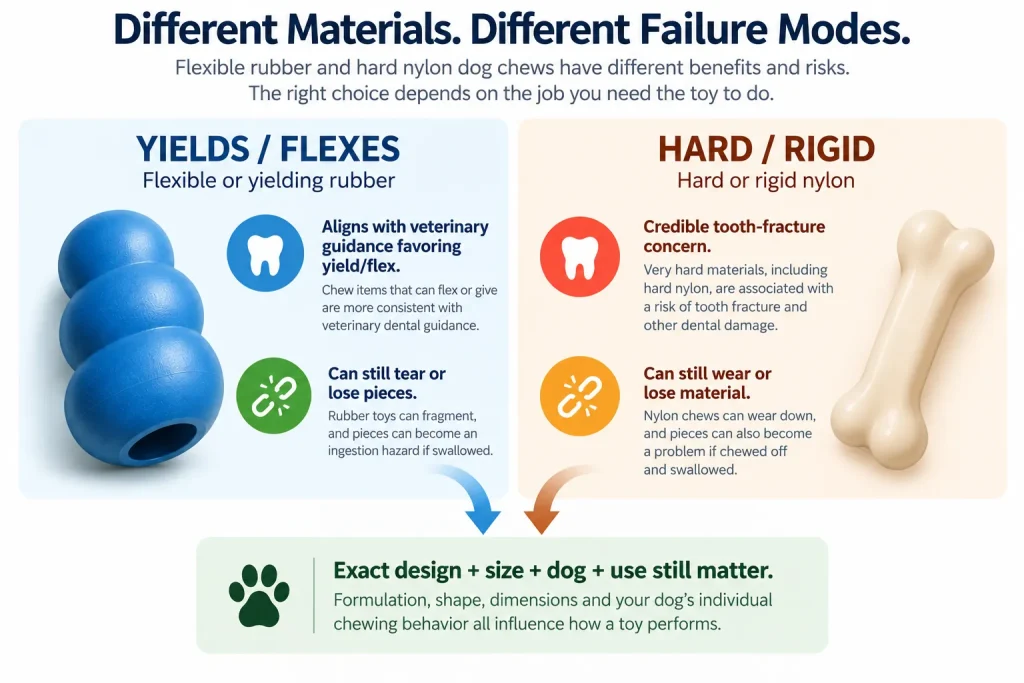
Quick Answer: Flexible or yielding rubber is more consistent with veterinary guidance that favors chew items able to flex or give on the dental-hardness axis, while hard or rigid nylon carries a credible tooth-fracture concern. But rubber can still tear, lose chunks, or become an ingestion hazard if pieces are swallowed. Current evidence does not establish a universal rubber-versus-nylon durability winner or an overall safer material. The relevant comparison is flexible/yielding rubber versus hard/rigid nylon, not every product carrying either material label.
Rubber vs Nylon Dog Chews at a Glance
| Decision question | Flexible / yielding rubber | Hard / rigid nylon |
|---|---|---|
| Does it flex or give? | Often, when the product is genuinely flexible | Much less in the hard/rigid category |
| Dental-hardness concern | More consistent with veterinary guidance favoring yielding toys | Specifically included in veterinary warnings about very hard chews |
| Can pieces become ingestible? | Yes, if torn or chunked | Yes, if pieces or material are removed and swallowed |
| Universal durability winner? | Not established | Not established |
| Stuffing, bounce, or interactive play? | Available in some designs | Depends on the exact design; no material-wide conclusion |
| Overall safer material? | Not established | Not established |
The table is intentionally not a scorecard. A more favorable result on one axis does not automatically mean a better overall choice.
The Important Difference Is Not Just “Rubber vs Nylon”
Flexible or yielding rubber is the relevant comparison
“Rubber” covers products with different formulations, thicknesses, shapes, and levels of flexibility. A toy that genuinely bends or gives under pressure belongs in a different physical category from a highly rigid object, even if both are marketed as durable chew toys.
Penn Vet specifically includes flexible rubber bones among acceptable toy examples in its dental guidance while warning that very hard materials can fracture teeth. That supports paying attention to yield and flexibility, rather than assuming every product labeled rubber has the same dental behavior.
It does not establish that every rubber toy is safe or suitable for every dog.
Hard or rigid nylon is the relevant nylon category
The same precision is necessary on the nylon side.
This guide is concerned with the hard, rigid nylon chews commonly intended for sustained chewing. Penn Vet specifically lists hard-nylon plastic bones among inappropriate very-hard items, while Tufts advises against chews that cannot bend, flex, or be indented with a thumbnail and explicitly includes hard nylon bones.
That supports a credible dental-hardness concern. It does not provide the probability that a particular nylon chew will fracture a particular dog’s tooth.
How the Materials Differ on Dental Hardness
Why yielding matters
Veterinary dental guidance gives the physical hardness of a chew real importance.
Penn Vet says very hard materials can fracture teeth and includes flexible rubber bones among acceptable examples. Tufts uses bend, flex, and thumbnail indentation as a practical screen. AAHA separately cautions against hard treats that can damage the structural integrity of the tooth.
Taken together, those sources give a defensible reason to favor yielding behavior over very hard, non-yielding behavior on the dental-hardness axis.
That qualification matters. It is not evidence that a flexible toy has zero dental risk or that rubber is universally safer across every other type of failure.
Why hard nylon raises a different concern
Hard nylon is not merely a theoretical example of a rigid material. Independent veterinary sources identify it specifically.
Penn Vet lists hard nylon plastic bones among very-hard items that can fracture teeth. Tufts also explicitly includes hard nylon bones in its warning against chews that fail its bend, flex, or thumbnail screen.
So a reader choosing a hard nylon chew should not treat tooth hardness as an issue that appears only in product reviews or manufacturer disclaimers. There is an independent veterinary basis for the concern.
What the evidence does not provide is an individual risk calculation. It does not tell us that a particular dog has a particular percentage chance of fracturing a tooth on a particular nylon model.
For the deeper evidence boundary, see our guide to hard nylon dog chews and tooth-fracture concern.
What this comparison still cannot tell you
There is no validated consumer cutoff that divides every chew toy neatly into “dentally safe” and “dentally unsafe.” The bend, flex, and thumbnail checks are practical veterinary screening heuristics, not safety certifications.
We also do not have a reliable rubber-versus-nylon tooth-fracture incidence rate, a dog-specific probability calculator, or evidence that rubber eliminates dental injury.
The evidence supports a hardness boundary. It does not erase uncertainty.
A More Yielding Material Does Not Eliminate Failure Risk
Rubber can tear or lose chunks
The ASPCA advises that rubber and hard-plastic toys are not intended for consumption and should not fragment into smaller pieces that can be swallowed. Texas A&M similarly notes that nylon and rubber toys can become a problem if a dog tears off and eats pieces that are too large to pass through the gastrointestinal tract.
So a flexible rubber toy can be more favorable on the dental-hardness axis while still being a poor fit for a dog that rapidly removes and swallows chunks.
Those are different failure modes.
Nylon can also lose material
Rigidity does not make a toy automatically ingestion-proof.
Texas A&M includes both nylon and rubber toys in its warning about dogs tearing off and swallowing pieces. Manufacturer guidance likewise treats nylon chews as nonedible products rather than material intended for consumption. That manufacturer guidance helps define intended use, but it does not establish a comparative ingestion-safety advantage over rubber.
We do not know which material has the lower ingestion-event rate
This is one of the most important evidence limits in the comparison.
We have evidence that swallowed toy material can matter. The American College of Veterinary Surgeons notes that toys can become gastrointestinal foreign bodies, and lodged foreign material may cause obstruction and sometimes require endoscopic or surgical removal.
What we do not have is good comparative evidence showing that rubber toys produce fewer gastrointestinal events than nylon chews, or vice versa.
A material-level ingestion winner is therefore not established.
Which Material Lasts Longer? The Evidence Does Not Give a Universal Winner
Durability is one of the easiest places to overstate the evidence.
Why manufacturer claims are not enough
Nylabone describes its nylon as wear-resistant, positions nylon for extreme chewers, and describes its rubber products as more flexible but less durable than its nylon products. Those statements are useful for understanding how that manufacturer positions its own product families.
They are not independent proof that nylon universally outlasts rubber.
KONG provides a useful counterexample to any simple rule that “rubber is for moderate chewers and nylon is for power chewers.” KONG positions its Extreme rubber formulation specifically for power chewers.
These manufacturer positions show that “power chewer” does not establish a universal material-selection rule. They do not establish that rubber and nylon are equally durable, either. Comparative longevity remains unresolved at the material level.
Formulation and design matter
Even within one manufacturer’s rubber line, formulation and size can change the intended durability profile. KONG distinguishes its Classic and Extreme rubber formulations and notes that increasing size also increases rubber thickness and can reduce the leverage a power chewer gets on the toy.
That illustrates why the label “rubber” alone cannot establish durability, but it still does not give us a universal rubber-versus-nylon longevity rule.
“Power chewer” is not a material-selection rule
Nylabone directs extreme chewers toward nylon. KONG explicitly directs power chewers toward its Extreme rubber formulation.
“Power chewer” does not, by itself, tell you whether a dog should use nylon or rubber.
It is product-positioning language, not a validated clinical material-selection class.

The Better Fit Also Depends on What You Need the Toy to Do
Sustained chewing
Manufacturers offer both hard-nylon chews and durable-rubber designs for sustained chewing, but those product-positioning claims do not establish a material-level winner.
The trade-off comes back to physical behavior: a hard nylon chew retains the dental-hardness concern, while a yielding rubber toy still needs to remain sufficiently intact for the individual dog’s chewing pattern.
Stuffing and food enrichment
Some rubber designs can perform jobs that a simple rigid chew may not be designed to perform.
For example, KONG’s Extreme design is made to be stuffed with food or treats. That is evidence about a particular design and product family, not proof that rubber is inherently more enriching.
Fetch, bounce, and interactive play
The same distinction applies to play. KONG describes its Extreme design as providing an unpredictable bounce for fetch.
These are capabilities of that design, as described by its manufacturer, not evidence that rubber as a material is inherently more enriching.
Which Material Profile Better Fits Your Decision?
State A: Yielding Rubber Better Fits the Job I Need
A yielding rubber profile may fit your decision better if avoiding a very-hard chew surface matters to you, if flexibility is part of what you want, or if you need a design that can also support jobs such as stuffing, food dispensing, bouncing, or fetch. If you have already chosen rubber and now need product-level options, see our rubber dog toys for aggressive chewers guide.
The exact product still needs to remain sufficiently intact for your dog’s use pattern.
This is a material-fit decision, not a declaration that rubber is risk-free or medically safe for every dog.
State B, Hard Nylon Still Fits the Job I Need, With a Dental-Hardness Trade-Off
Some readers may still choose a hard nylon chew because the intended use or product characteristics fit what they are looking for.
That choice does not make the dental evidence disappear.
Hard or rigid nylon retains the tooth-fracture concern described by independent veterinary sources. This state is not a dental-safety clearance.
GetDogVerdict cannot determine whether that uncertainty is acceptable for an individual dog.
State C: Neither Material Profile Clearly Fits
A forced rubber-versus-nylon choice is not always useful.
Perhaps your dog rapidly destroys yielding rubber, while you do not want to accept the hardness profile of a rigid nylon chew. Perhaps neither option performs the job you need. Or perhaps the exact product evidence is not strong enough to justify either choice.
In that case, neither material profile clearly fits is a valid conclusion.
If you have already decided that a rubber format fits your dog better, continue to our Best Rubber Dog Toys for Aggressive Chewers guide for product-level fit and failure modes. Otherwise, you can explore broader options for aggressive chewers rather than forcing the decision back into rubber versus nylon.
If You Already Own the Toy, Condition Is a Different Decision
Material selection and current toy condition are separate questions.
This article asks whether a material profile fits the job you need. If the toy you already own is losing pieces, has materially changed, or shows other wear that makes you question continued use, the next task is a condition assessment rather than another material comparison.
See how to assess whether your current chew toy should be retired.
What the Evidence Still Cannot Tell Us
The available evidence does not establish:
- a comparative rubber-versus-nylon tooth-fracture incidence rate;
- a comparative choking or gastrointestinal-event incidence rate;
- a dog-specific risk probability;
- a universal durability winner;
- an overall safest material;
- a validated consumer hardness threshold;
- a comparative risk ranking across rubber formulations; or
- a quantified amount by which supervision changes these outcomes.
These gaps should not be interpreted as proof in either direction. The evidence is strong enough to identify meaningful trade-offs, but not strong enough to collapse those trade-offs into one universal ranking.
When This Stops Being a Material-Choice Question
If you see visible tooth damage, apparent oral pain or swelling, or a meaningful change in chewing or eating behavior, the question has moved beyond choosing a toy material.
Likewise, if you know or suspect that part of a toy was swallowed, especially when there are signs of gastrointestinal illness, veterinary evaluation belongs ahead of another rubber-versus-nylon comparison.
Veterinary dental sources document the need to evaluate fractured teeth, while the American College of Veterinary Surgeons identifies swallowed toys and other nondigestible objects as potential gastrointestinal foreign bodies.
This guide cannot diagnose an injury, determine whether a particular toy caused it, or provide an individual prognosis.
Your Next Question Depends on What You Are Deciding
If you want product-level options for an aggressive chewer
Continue to Best Dog Toys for Aggressive Chewers: Evidence-Based Options and Trade-Offs.
If you want the deeper dental evidence on hard nylon
Continue to Are Hard Nylon Dog Chews Safe for Dogs’ Teeth? What the Evidence Shows.
If the toy you already own is showing wear or damage
Continue to When Should You Replace a Dog Chew Toy? Signs It’s Time to Retire It.
How GetDogVerdict Compared the Evidence
GetDogVerdict separated independent veterinary guidance from manufacturer evidence.
Independent veterinary and animal-health sources were used to establish the dental-hardness boundary, fragmentation and foreign-body concerns, and the limits of what those risks can tell us. Manufacturer sources were used for narrower questions such as material formulation, intended use, product positioning, stuffing, bounce, and supervision instructions.
Manufacturer descriptions were not treated as independent proof of safety or comparative durability.
We did not physically evaluate the products discussed here. Where the evidence did not establish a comparative incidence rate, universal durability winner, or overall safest material, that uncertainty was preserved rather than replaced with an assumption.
The meaningful choice is not simply one material name versus another. It is how a yielding toy and a rigid chew change the failure modes you need to think about, and whether that profile fits the job you need the toy to perform.